| 📰 Title: | Galdr | 🕹️ / 🛠️ Type: | Tool |
|---|---|---|---|
| 🗃️ Genre: | Development | 👁️ Visual: | Fixed screen |
| 🏷️ Category: | Development ➤ Audio Production ➤ Synthesizer | 🏝️ Perspective: | First person (interface) |
| 🔖 Tags: | Development; Audio Production; Synthesizer; JUCE; Plugins system; Standalone; VST3; CLAP | ⏱️ Pacing: | Real Time |
| 🐣️ Approx. start: | 2026-08-02 | 👫️ Played: | Single |
| 🐓️ Latest: | 2026-08-10 | 🚦 Status: | 05. Tested & Working (status) |
| 📍️ Version: | Latest: 1.1.0 // Dev: b8cb3d5 | ❤️ Like it: | 2. 👏️⭐⭐⭐⭐ (excellent) |
| 🏛️ License type: | 🕊️ Libre | 🎀️ Quality: | 1. 🏆️⭐⭐⭐⭐⭐ (perfect) |
| 🏛️ License: | GPL-3+ | ⭐ (temporary): | |
| 🎰️ ID: | 16648 | 🐛️ Created: | 2026-08-13 |
| 💡 Lights on: | 🚧️ Some work remains to be done: | ||
|---|---|---|---|
| 📰 What's new?: | 💥️ New | 💭️ New version published (to be updated): | |
| 🦣️ Awaiting publication on Mastodon: | 🎨️ Significant improvement: | ||
| 🦺️ Work in progress: | 🎖️ This work: |  |
|
| 📰 Previous News: | 🛜️ RSS (on RSS Guard): |  |
|
| 👫️ Contrib.: | goupildb | 🛜️ Reading frequency: | 0w (well-spaced updates) |
| 🐜️ Updated: | 2026-08-13 |
| 📦️ Package name: | ..... 📦️ Arch: | ||
|---|---|---|---|
| 📄️ Source: | |
..... 📦️ RPM: | |
| ⚙️ Generic binary: | |
..... 📦️ Deb: | |
| 🌍️ Browser version: | ..... 📦️ AppImage: | ||
| 📱️ Mobile support: | ..... 📦️ Flatpak: | ||
| 🧹️ Not use: | ..... 📦️ Snap: |
| 📜️[en]: | A libre, multiplatform synthesizer with a black metal soul. It features a 12-voice engine with poly, mono, and legato modes; 2 band-limited oscillators (PolyBLEP); up to 7 voices in unison with detuning and stereo spreading; a sub-oscillator and white/pink noise; FM modulation and hard sync for aggressive metallic timbres, as well as analog drift per voice, a morphing wavetable (32 frames), a multimode filter (12/24 dB LP, HP, BP, and vowel formant) with drive, an 8-slot modulation matrix, a tempo-synced arpeggiator, 2 LFO, glide, separate amplitude and filter envelopes, MPE-compatible per note pitch bend and pressure, a “Genre” effects chain with 2× oversampled nonlinear stages, a “Blizzard” granular texture layer, tempo-synced LFOs, tremolo, and delay, a preset browser with factory and custom presets, an oscilloscope and spectrum analyzer, and an on-screen MIDI keyboard. | 📜️[fr]: | Un synthétiseur libre et multiplateforme à l’âme black metal. Il offre notamment un moteur à 12 voix avec modes poly, mono et legato, 2 oscillateurs à bande limitée (PolyBLEP), jusqu’à 7 voix à l’unisson avec désaccordage et étalement stéréo, sous-oscillateur et bruit blanc/rose, une modulation FM et synchronisation dure pour des timbres métalliques agressifs, ainsi qu’une dérive analogique par voix, une table d’ondes morphing (32 trames), un filtre multimode (LP 12/24 dB, HP, BP et formant vocalique) avec drive, une matrice de modulation à 8 emplacements, un arpégiateur synchronisé au tempo, 2 LFO glissando, enveloppes d’amplification et de filtre séparées, un pitch bend et pression par note compatibles MPE, une chaîne d’effets « Genre » avec étages non linéaires suréchantillonnés 2×, une couche de texture granulaire de tempête de neige (Blizzard), la synchronisation au tempo pour les LFO, le trémolo et le délai, un navigateur de préréglages avec préréglages d'usine et personnalisés, oscilloscope et analyseur de spectre, clavier MIDI à l'écran. |
|---|
🎲️ Gameplay: (202608), (202608),
🎮️ Showcase: (202608),
🏡️ Website & videos
• Website: [Homepage] [Dev site] [Features/About] [Screenshots]
• Videos: t(202xxx) gd(202xxx) gu(202xxx) r(202xxx) lp(202xxx) ht(202xxx) d(202608) g(202608) g(202608) g[fr](202xxx) g[de](202xxx) g[ru](202xxx) g[pl](202xxx) g[cz](202xxx) g[sp](202xxx) g[pt](202xxx) g[it](202xxx) g[tr](202xxx)]
• Doc: [WIKI] [FAQ]
• Updates: [RSS] / [Changelog 1(news/blog) 2(release notes) 3(tags) 4(commits)]
💰 Commercial
• (empty):
🍩️ Resources
• (empty, license): [Homepage] [Dev site] 🎬️ g(202xxx)
🛠️ Technical informations
[PCGamingWiki] [MobyGames]
🦣️ Social
Devs (Galdr Team 1 2 [fr] [en]): [Site 1 2] [Chat] [mastodon] [Bluesky] [PeerTube] [YouTube] [PressKit] [Interview 1(202xxx) 2(202xxx)]
Devs (Andrea De Murtas (Sognevo, andreademurtas) 1 2 [fr] [en]): [Site 1 2] [Chat] [mastodon] [Bluesky] [PeerTube] [YouTube] [PressKit] [Interview 1(202xxx) 2(202xxx)]
The Project: [Blog] [Chat] [Forums] [mastodon] [Bluesky] [PeerTube] [YouTube] [PressKit] [Lemmy] [reddit] [Discord]
🐝️ Related
📦️ Misc. repositories
[Repology] [pkgs.org] [Generic binary] [Arch Linux / AUR] [openSUSE] [Debian/Ubuntu] [Flatpak] [AppImage(author's repo)] [Snap] [PortableLinuxGames]
🕵️ Reviews
[HowLongToBeat] [metacritic] [OpenCritic] [iGDB]
🕊️ Source of this Entry: [NunD [de] (20260803)]
🦣️ Social Networking Update (on mastodon)
🛠️️ Title: Galdr
🦊️ Idea: A libre synthesizer with a black metal soul
🏡️ https://sognevo.com/galdr/
🐣️ https://github.com/andreademurtas/galdr
🔖 #LinuxGameDev #Flagship #Music #Synthesizer
📦️ #Libre #Bin
📕️ https://lebottinlinux.vps.a-lec.org/LO.html
🥁️ Update: 1.1.0
🕵 1.1.0: 👏️⭐⭐⭐⭐
⚗️ Minor vers. 🐁️
📌️ Changes: https://github.com/andreademurtas/galdr/releases
🦣️ From: https://social.tchncs.de/@nund/117031602605018069
(Thanks also to PlayingTux for retweeting the message)
🛜️ https://github.com/andreademurtas/galdr/tags.atom
🎲️ https://www.youtube.com/embed/D-ytTbiQpos
🎲️ https://www.youtube.com/embed/2h45hyGOQho
🎮️ https://www.youtube.com/embed/rPcptytwAzU
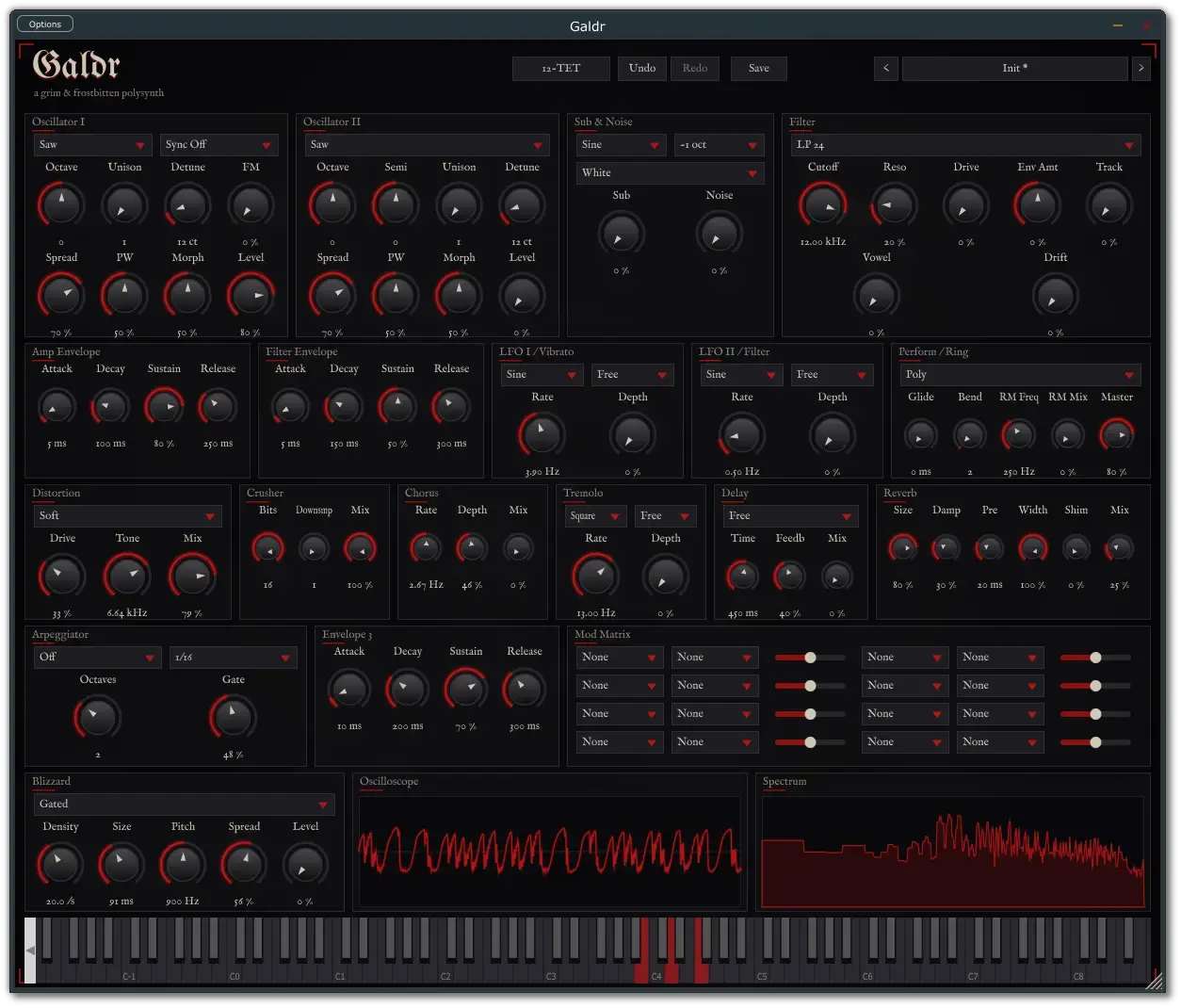
🕶️ A view of its UI (v. 1.1.0, with a black-and-red theme, on my Linux PC) in use. A MIDI keyboard is displayed at the bottom of the interface, with two oscilloscopes above it, and dozens of knobs and buttons.
📚️ Galdr is a libre, multiplatform synthesizer with a black metal soul. It features a 12-voice engine with poly, mono, and legato modes; 2 band-limited oscillators (PolyBLEP); up to 7 voices in unison with detuning and stereo spreading; a sub-oscillator and white/pink noise; FM modulation and hard sync for aggressive metallic timbres, as well as analog drift per voice, a morphing wavetable (32 frames), a multimode filter (12/24 dB LP, HP, BP, and vowel formant) with drive, an 8-slot modulation matrix, a tempo-synced arpeggiator, 2 LFO, glide, separate amplitude and filter envelopes, MPE-compatible per note pitch bend and pressure, a “Genre” effects chain with 2× oversampled nonlinear stages, a “Blizzard” granular texture layer, tempo-synced LFOs, tremolo, and delay, a preset browser with factory and custom presets, an oscilloscope and spectrum analyzer, and an on-screen MIDI keyboard.
🕵 1.1.0: 👏️⭐⭐⭐⭐
⚪️ I'm not a musician, and I don't have the necessary skills, but I do have a small MIDI keyboard to run some basic tests and get a sense of whether the tool works and seems high-quality to me.
🟢️ It recognizes my MIDI keyboard, so I was able to run a few basic tests and adjust the sound using its many knobs.
🟢️ An excellent tool. The sound is very synthetic, the tool is very comprehensive, and it will undoubtedly allow specialists to produce the metallic sound they’re looking for.
📜️ "A libre synthesizer with a black metal soul" 📜️
galdr, Old Norse: a spell sung rather than spoken.
A free and open-source synthesizer with a black-metal soul, built with JUCE. Sibling of Gala and Gjalla.
Features
✅️ 12-voice engine with poly, mono and legato modes
✅️ Two band-limited (PolyBLEP) oscillators, up to 7-voice unison with detune and stereo spread, sub oscillator and white/pink noise
✅️ FM (osc 2 modulates osc 1) and hard sync for aggressive metallic timbres, plus per-voice analog drift
✅️ Morphing wavetable mode: 32 mip-mapped frames sweeping from sine through saw to an inharmonic “grim” spectrum
✅️ Multimode filter (LP 12/24 dB, HP, BP and vowel formant) with drive, dedicated envelope and keytracking
✅️ 8-slot modulation matrix (LFOs, envelopes, velocity, mod wheel, pressure, per-note random) routable to pitch, morph, cutoff, FM, FX sends and more, with a free third envelope
✅️ Tempo-synced arpeggiator (up/down/up-down/random/as-played, up to 4 octaves)
✅️ Two LFOs, glide, separate amp and filter envelopes
✅️ MPE-friendly per-note pitch bend and pressure; Scala (.scl) microtuning
✅️ Genre FX chain with the nonlinear stages oversampled 2×: four-flavour distortion, bitcrusher, ring modulator, chorus, tremolo picking, delay and a dark FDN cavern reverb with predelay and octave-up shimmer
✅️ “Blizzard”: a granular snowstorm texture layer, gated by note activity or free-running as a continuous drone
✅️ Tempo sync for LFOs, tremolo and delay (musical divisions of the host tempo)
✅️ Preset browser with factory and user presets, oscilloscope and spectrum analyser, on-screen MIDI keyboard
✅️ Dark-fantasy themed GUI, resizable, with tooltips
About
Sognevo is the label I put on the audio software I build. There is no company behind it and nothing for sale: the plugins are free software in both senses. They cost nothing, and the source is on GitHub under the GNU GPLv3, so you can use them on any recording, fork them, or take the code apart to see how they work.
They also don't ask for accounts, don't send telemetry and won't ever grow a paid tier. If something breaks, or you wish a knob existed, open an issue on the plugin's repository or write to andrea@sognevo.com.
Un synthétiseur libre à l’âme black metal, par la Galdr Team, initié par Andrea De Murtas (Sognevo, andreademurtas).
Il utilise le framework JUCE.
Galdr est un synthétiseur libre et multiplateforme à l’âme black metal. Il offre notamment un moteur à 12 voix avec modes poly, mono et legato, 2 oscillateurs à bande limitée (PolyBLEP), jusqu’à 7 voix à l’unisson avec désaccordage et étalement stéréo, sous-oscillateur et bruit blanc/rose, une modulation FM et synchronisation dure pour des timbres métalliques agressifs, ainsi qu’une dérive analogique par voix, une table d’ondes morphing (32 trames), un filtre multimode (LP 12/24 dB, HP, BP et formant vocalique) avec drive, une matrice de modulation à 8 emplacements, un arpégiateur synchronisé au tempo, 2 LFO glissando, enveloppes d’amplification et de filtre séparées, un pitch bend et pression par note compatibles MPE, une chaîne d’effets « Genre » avec étages non linéaires suréchantillonnés 2×, une couche de texture granulaire de tempête de neige (Blizzard), la synchronisation au tempo pour les LFO, le trémolo et le délai, un navigateur de préréglages avec préréglages d'usine et personnalisés, oscilloscope et analyseur de spectre, clavier MIDI à l'écran.
galdr, en vieux norrois : un sortilège chanté plutôt que prononcé.
Un synthétiseur libre à l’âme black metal, développé avec JUCE. Cousin de Gala et Gjalla.
Caractéristiques
✅️ Moteur à 12 voix avec modes poly, mono et legato
✅️ Deux oscillateurs à bande limitée (PolyBLEP), jusqu’à 7 voix à l’unisson avec désaccordage et étalement stéréo, sous-oscillateur et bruit blanc/rose
✅️ Modulation FM (l’oscillateur 2 module l’oscillateur 1) et synchronisation dure pour des timbres métalliques agressifs, ainsi qu’une dérive analogique par voix
✅️ Mode de table d’ondes morphing : 32 trames avec mappage MIP, balayant de la sinusoïde à la dent de scie jusqu’à un spectre « sinistre » non harmonique
✅️ Filtre multimode (LP 12/24 dB, HP, BP et formant vocalique) avec drive, enveloppe dédiée et suivi de la vélocité
✅️ Matrice de modulation à 8 emplacements (LFO, enveloppes, vélocité, molette de modulation, pression, aléatoire par note) routable vers la hauteur, le morphing, la fréquence de coupure, la FM, les envois d’effets et plus encore, avec une troisième enveloppe libre
✅️ Arpégiateur synchronisé au tempo (haut/bas/haut-bas/aléatoire/tel que joué, jusqu’à 4 octaves)
✅️ Deux LFO, glissando, enveloppes d’amplification et de filtre séparées
✅️ Pitch bend et pression par note compatibles MPE ; micro-accordage Scala (.scl)
✅️ Chaîne d’effets « Genre » avec étages non linéaires suréchantillonnés 2× : distorsion à quatre profils, bitcrusher, modulateur en anneau, chorus, trémolo de picking, délai et une réverbération caverneuse FDN sombre avec pré-délai et scintillement d’octave supérieure
✅️ « Blizzard » : une couche de texture granulaire de tempête de neige, déclenchée par l’activité des notes ou fonctionnant librement comme un bourdonnement continu
✅️ Synchronisation au tempo pour les LFO, le trémolo et le délai (divisions musicales du tempo de l’hôte)
✅️ Navigateur de préréglages avec préréglages d'usine et personnalisés, oscilloscope et analyseur de spectre, clavier MIDI à l'écran
✅️ Interface graphique sur le thème de la « dark fantasy », redimensionnable, avec des infobulles
À propos
Sognevo est le nom que j’ai donné aux logiciels audio que je développe. Il n’y a aucune entreprise derrière ce projet et rien n’est à vendre : les plugins sont des logiciels libres au double sens du terme. Ils sont gratuits, et le code source est disponible sur GitHub sous licence GNU GPLv3. Vous pouvez donc les utiliser pour n’importe quel enregistrement, créer un fork ou disséquer le code pour comprendre leur fonctionnement.
Ils ne nécessitent pas non plus de compte, n’envoient pas de données de télémétrie et ne proposeront jamais de formule payante. Si quelque chose ne fonctionne pas, ou si vous aimeriez qu’un bouton soit ajouté, ouvrez un ticket sur le dépôt du plug-in ou écrivez à andrea@sognevo.com.
⚙️ Installation à partir du binaire
⛓️ Installation à partir du binaire classique :
• Un binaire statique est disponible, décompressez le livrable, et rendez son binaire exécutable (clic droit sous votre gestionnaire de fichier).
↪ vous obtenez notamment le(s) livrable(s) suivant(s) : Galdr
📄️ Installation à partir du source
• Source non testé.
🚀️ LANCEMENT DE L'INTERFACE
▸ Classique :
• Si vous l'avez installé à partir d'un paquet / dans l'un des répertoires système : [Alt+F2] Galdr ou en console : $ Galdr
• Ou, rendez son binaire exécutable (clic droit sous votre gestionnaire de fichier) et cliquez dessus, ou dans le répertoire où se trouve le binaire lancez : $ ./Galdr
💡 Nota : si vous l'avez installé via votre gestionnaire de paquets et ne connaissez pas le nom précis du binaire, sélectionnez le paquet dans votre gestionnaire, et dans l'onglet “Fichiers” recherchez son nom dans l'arborescence d'installation (le binaire est généralement installé dans /usr/bin/).
● 📜️ Préambule :
⚬ 1ere édition : le 13 août 2026 sous Manjaro. Par : goupildb. ⏱️ Durée du test : 10 minutes. 🎯️ Objectif : Initialisation de l'entrée, tests et premières impressions.
● 💻️ PC specs :
Linux distribution: Manjaro
Kernel: 7.1.6-1-MANJARO +iw (pour le wi-fi) + acpi_call-dkms + rapiddisk-dkms + uwurandom-git-dkms + v4l2loopback-dkms
Graphics driver: NVIDIA 610.57.04 (proprietary version, via Manjaro)
Desktop environment: X-Cinnamon (6.6.9) / Xorg 11.0 (21.1.24)
CPU: AMD Ryzen 7 2700X (3,7GHz, 8 cores)
Motherboard: MSI B450 GAMING PRO CARBON AC (RVB) + (zenpower-dkms + zenpower3-dkms + iwlwifi-ax101-dkms)
RAM: 32Go DDR4 (2x16GB)
Graphics card: GeForce RTX 2070 (TU106)
Hard disk: 1TB NVMe Force MP510 + 2x4TB Seagate Barracuda + 2x12TB Seagate IronWolf
Monitors: 1 x ASUS ROG Swift PG348Q (3440x1440) (The other died after a micro-power cut 😤️) + 1 x ASUS ROG Swift OLED PG48UQ 47,5" (3840x2160) (Get used to it 🦒️)
Webcam: Logitech HD Pro Webcam C920 (1080p@30FPS, stereo mic.)
Microphone: Samson G-Track pro Condenser
Keyboard: Keychron K1 Pro
MIDI keyboard: ARTURIA Minilab 3
Mouse: G-Lab Kult-Iridium (RVB)
Tablet: WACOM PTZ-930 (Intuos 3) (input-wacom-dkms-patched required)
Printer: brother MFC-L2800DW (brother-mfc-l2820dw (Print) + brscan5 (Scan) required).
Gamepads (test: jstest-gtk):
- (USB): Logitech Rumblepad (2 analog pads, one digital pad, + force feedback).
- (Bluetooth): Microsoft Xbox Elite Wireless Controller Series 2 (xpadneo-dkms required + Plugging & unplugging the gamepad to load the driver. If necessary, leave the gamepad connected)(drift | not recognized by games if battery low)
● 🫕️ Installation :
‣ (✔ v. 1.1.0) Binaire classique : FONCTIONNEL.
🟢️ Il est très facile à installer et à lancer grâce au binaire fourni.
● 🧪️ Tests effectués :
▸ 🧫️ Conditions du test, objectif(s)
‣ 🔍️ (v. 1.1.0) : ✔ tested
‣ ◀️ Test binaire de fonctionnement : ✔ tested
⚪️ Ce test avait pour objectif de faire une copie d'écran, de vérifier que le jeu/outil démarre, qu'aucun bug apparent ne survient, qu'il fonctionne avec des opérations basiques, de survoler son interface pour me faire une idée de ses fonctionnalités,
⚪️ Point à prendre en considération : je ne suis pas musicien et n'ai aucune connaissance dans le domaine, je n'ai un clavier MIDI que pour tester ce type d'outils.
● 🌻️ Premières impressions :
🟢️ L'interface est à la fois simple et extrêmement complète, elle reconnaît mon clavier ARTURIA Minilab 3 dans ses paramètres, c'est un jeu d'enfant de l'utiliser.
🟢️ Le son est très synthétique. Des dizaines de potentiomètres permettent de le modifier.
● 🧭️ Conclusion :
🕵️ Impression globale : 👍️
❤️ Like it: 👏️⭐⭐⭐⭐ (excellent)
🎀️ Quality: 🏆️⭐⭐⭐⭐⭐ (perfect)
⚪️ Je ne suis pas musicien, je n'ai pas les compétences requises, néanmoins j'ai un petit clavier MIDI pour réaliser des tests basiques et me faire une idée si l'outil fonctionne et me semble de qualité.
🟢️ Il reconnaît mon clavier MIDI et j'ai donc pu réaliser quelques tests basiques et modifier le son via ses nombreux potentiomètres.
🟢️ Un excellent outil. Le son est très synthétique, l'outil est très complet et permettra sans aucun doute aux spécialistes de produire le son métallique qu'ils souhaitent.
👏️ ❤️ Un grand bravo et merci (notamment pour la version Linux !) à son/ses auteur(s) !